North Midlands Society of Rugby Football Referees: Est. 1920
Subject: Important Update: RFU Regulation 19 (Discipline) Review
I hope this message finds you well. I am writing to provide you with an important update regarding RFU Regulation 19 (Discipline), which has undergone a comprehensive review ahead of the 2024/25 season.
As you may know, Regulation 19 applies to all clubs at every level of the game. Over time, it has been updated in a piecemeal fashion, resulting in a regulation that became cumbersome, overly legalistic, and complex in certain areas. Recognizing this, the Regulation 19 Review Group was established to refresh and streamline the regulation, making it easier to understand and more user-friendly for all.
The review was guided by the principles of Accuracy, Brevity, and Clarity (ABC). The primary goal was to create a regulation that is simple, understandable, and consistently applicable. The review also aimed to avoid repetition and incorporate improvements from lessons learned while ensuring the regulation aligns with World Rugby’s core principles.
While the vast majority of Regulation 19’s content has been retained, it has been restructured and rewritten for improved clarity. Below are the key changes:
The review group included representatives from various regions and expertise within the RFU, including:
I encourage you to familiarise yourself with the updated Regulation 19 ahead of the upcoming season. Should you have any questions or require further clarification, please do not hesitate to reach out.
Regulation 19 RFU Website Link
The RFU (Rugby Football Union) is committed to upholding the core values of rugby and maintaining respect for match officials. As part of this commitment, the RFU Head of Judiciary has issued guidance on sanctions related to Match Official Abuse (MOA). This guidance outlines the different forms of MOA, the corresponding sanctions, and the importance of maintaining a fair and consistent disciplinary process.
Match Official Abuse can take various forms and may occur during or after a game. It can involve:
The RFU has established clear guidelines for discipline panels to follow when determining the appropriate sanctions for MOA offenses. These guidelines ensure consistency across all levels of rugby in England.
Sanctions for MOA offenses are categorized into three levels based on the seriousness of the offense:
The starting point for each category is determined by the severity of the offense, as outlined in RFU Regulation 19. Discipline panels must impose sanctions based on the specific facts of each case while ensuring fairness and consistency.
From January 1, 2024, any MOA offense will carry additional penalties:
These aggravated sanctions are designed to deter MOA and emphasize the importance of respecting match officials.
Match Official Abuse is a significant concern for the RFU. In the 2022-2023 season, MOA accounted for 18% of all disciplinary cases in the community game. Surveys revealed that 49% of match officials experienced abuse during the previous season, contributing to the loss of referees from the game.
To address this, the RFU has increased sanctions for MOA to deter players from disrespecting match officials. These stronger penalties aim to protect match officials and ensure their continued participation in the game.
While each MOA case is unique, it is crucial that similar offenses receive consistent sanctions across all levels of rugby. This ensures fairness and upholds the integrity of the game. The RFU’s guidance replaces any previous disciplinary memoranda, providing a standardized approach to MOA sanctions.
Discipline panels must apply the mandatory aggravating factors after determining the appropriate starting point and considering any mitigating circumstances. Panels retain the discretion to suspend part of a sanction or impose alternative penalties, such as requiring the offender to attend a refereeing course.
For more detailed guidance on MOA and the disciplinary process, referees and clubs are encouraged to consult the RFU’s “Match Official Abuse – A Guide for Referees” and seek advice from their referee society or CB discipline secretary.
For any further inquiries or clarification, please contact the RFU discipline team at disciplineRFU@rfu.com.
GUIDE FOR REFEREES ON MATCH OFFICIAL ABUSE
The term “Match Official Abuse” encompasses various forms of misconduct, ranging from verbal or physical abuse to offensive gestures. Abuse can originate from players, coaches, parents, or spectators, and may occur during or after a game.
Eliminating Match Official Abuse is crucial to upholding the integrity and values of the Game. Referees should adopt a zero-tolerance approach to such behavior and respond decisively when it occurs. On-field sanctions are available to deal with immediate abuse, and the RFU disciplinary process ensures that proven cases result in appropriate consequences based on World Rugby guidelines.
Referees must be able to recognize abuse and know the proper responses.
The RFU disciplinary process identifies five categories of match official abuse, each with its corresponding disciplinary actions. Referees must respond promptly and appropriately, even when it’s not immediately clear which category the abuse falls under. Disciplinary authorities will review the evidence and determine the appropriate charges.
All forms of on-field match official abuse are covered under Law 9.28 of the World Rugby Laws of the Game.
A well-written and detailed report is essential for the disciplinary process. It should allow the Disciplinary Panel to determine the appropriate sanction without needing the match official to attend the hearing.
Referees can seek assistance from their Referee Society in drafting the report.
Key Report Elements:
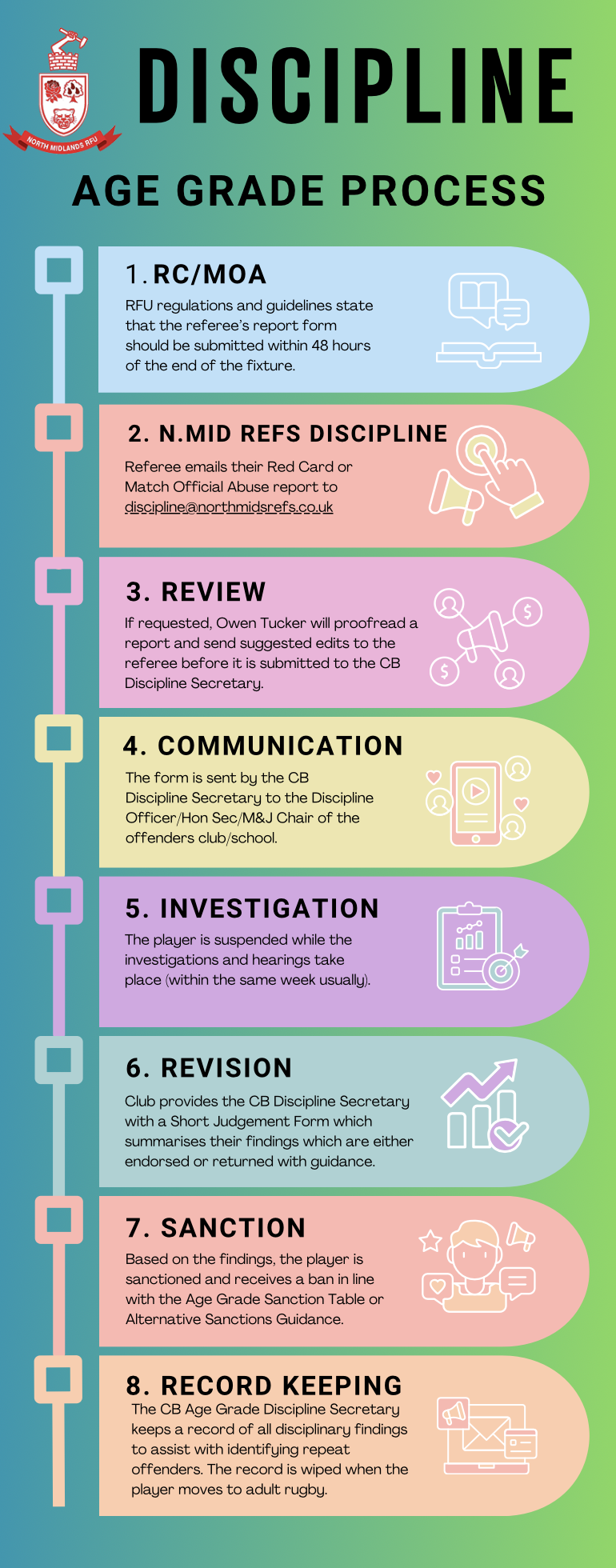
In Age Grade matches, similar principles apply, but the disciplinary processes may differ. If the match official is under 18, safeguarding issues may arise, and the case will be referred to both the Discipline and Safeguarding teams.
Adult offenders in these cases will be dealt with by the CB Discipline Secretary using adult sanction guidelines.
For advice on completing a report or any aspect of the disciplinary process, referees should contact their Referee Society or the CB Discipline Secretary. The RFU is also available for guidance.
Decided disciplinary cases reported on the RFU website [Englandrugby.com] may provide some guidance in determining whether words directed at the Match Official should be categorized as disrespecting the authority of the Match Official or verbal abuse of a Match Official. However, they do not constitute binding precedents as no two cases are the same.
Match Officials must be allowed some margin of error as identified errors can be corrected by the disciplinary process. To assist Match Officials in distinguishing between disrespect/dissent and verbal abuse (or threatening words or behavior), hypothetical examples are set out below, along with suggestions for their categorization.
The following examples would properly be categorized as disrespecting the authority of the Match Official:
With the possible exception of example 3, all of the above scenarios would justify an on-field red card.
The following examples would properly be categorized as verbal abuse of the referee, warranting a red card:
The following examples would properly be categorized as using threatening words or behavior:
A disciplinary panel has the ability to amend the charge if appropriate after hearing evidence from the parties involved or if there is an error in the presentation of the case.
| Charge | Definition of Charge | Example |
|---|---|---|
| Disrespecting the Authority of the Match Official | Often referred to as ‘dissent’ rather than Match Official Abuse. It involves questioning a decision of the Match Official. | “Are you fucking serious?” “That’s fucking bullshit, ref.” “Are you having a laugh?” “Are you fucking joking?” “That’s fucking pathetic.” Non-verbal examples include: – Throwing the ball away – Refusing to follow the direction of the Match Official – Refusal to give a name when asked |
| Verbal Abuse of a Match Official | This occurs when the offender uses foul or offensive language in comments aimed directly at the Match Official. Any comments that question the integrity of the Match Official should be considered as abuse. | “You’re a fucking joke.” “You’re fucking pathetic.” “You’re fucking useless.” “Are you a retard?” “You’re a cheat.” “Come on lads, we’re playing against 16 here.” |
| Physical Contact with a Match Official | Often referred to as ‘making incidental contact with a Match Official’. It occurs when contact with the Match Official is more than merely accidental. | A player moving the referee out of the way at a breakdown or to make a tackle. NB: It is common for a referee to initially apologize for their positioning; however, this does not prevent a charge being issued on review. |
| Physical Abuse of a Match Official | The offender intentionally makes physical contact with the Match Official – i.e., physical contact that cannot be categorized as merely reckless, careless, or purely accidental. | A player charging into a ref. A player pushing the referee with force Any punch, strike, or kick |
| Threatening Actions or Words Towards a Match Official | This occurs when a specific threat is made to the Match Official either verbally or by physical gesture, but there is no physical contact between the offender and the referee. | “I’m going to punch your lights out.” “I’m going to smash your car up.” “I wouldn’t come into the clubhouse if I were you.” |
Any RFU or CB disciplinary panel is obliged to follow the World Rugby approved sanction table for offences that receive a Red Card. These sanctions for the adult game are set out below:
Verbal abuse includes, but is not limited to, abuse based on: religion, colour, national or ethnic origin, sexual orientation.
The sanction table for the Adult game can be found in RFU Regulation 19, Appendix 2, while the sanction table for the Age Grade game can be found in RFU Regulation 19, Appendix 6. If the person involved is a YMO (Young Match Official) or U18 Match Official, the sanction table has a new provision of a minimum mid-range entry point for any offence under Law 9.28 in which they are involved.
Note: Certain CB’s have informed all their clubs that MOA offences can be aggravated by a set number of weeks. These weeks are added to the World Rugby sanction.
When a charge is issued by the RFU/CB for a breach of Rule 5.12 (an act not in the interests of the Game), the Disciplinary Panel has the ability to impose any sanction which may include a warning or reprimand, a fine, or suspension from Playing/Coaching/Spectating, or any combination of these. While the sanction must be proportionate to the offending, a panel can also mandate an individual or a club to complete an alternative sanction, in addition to a match sanction.
Recent examples of alternative sanctions directed by Panels include:
All RFU judgments are published in full on the RFU website. All CB MOA case summaries are also published on the RFU website.
This section is to assist both the Match Official and any Disciplinary Panel in deciding the appropriate action.
Q: Can a Referee Coach submit a MOA report on behalf of the Referee?
A: Only the Match Official who was subject to any abuse can submit a report.
Q: Who can submit a MOA report?
A: Any Match Official can submit a MOA report. It is then up to the relevant Disciplinary Secretary to determine if charges should be issued.
Q: How long after a match can a Match Official submit a MOA report?
A: Regulations 19.4.1-19.4.6 stipulate that a report must be submitted as soon as practicable and no later than 9 a.m. on the second day following the match.
Q: Can comments in the clubhouse be considered as MOA?
A: If any abuse is aimed at a Match Official in relation to their performance in the role, then the Match Official can submit a MOA report. This could include comments made to a Match Official in the clubhouse.
Q: Can comments on social media be reported as MOA?
A: If the comments relate to the performance of a Match Official and are made by someone under the jurisdiction of the RFU, charges can be issued for any public comments, including those made online.
Q: If a Match Official issues a Yellow Card for an offence, can they subsequently submit a MOA report for the same offence?
A: If an incident warrants a Red Card, it should be issued at the time of the incident. The only exception is when a Match Official has been subjected to physical contact and forms a different opinion after reviewing new information that was not available at the time of the incident.
Q: Do the Disciplinary Panel have to follow the World Rugby approved sanction table?
A: If a Red Card is issued, the panel is bound by the sanction table. If a MOA report is issued, the panel will treat the case as a breach of RFU Rule 5.12 and has the discretion to consider any sanction. Most panels will use the World Rugby sanction table as a guide but have the ability to consider alternate sanctions and suspend an element of the sanction.
Q: What can the Disciplinary Panel do if the person responsible for any MOA is not under the jurisdiction of the RFU?
A: The Disciplinary Panel will investigate if they have jurisdiction. If it is found that they do not, they may consider issuing charges against the relevant club for failure to control the individual concerned.
Q: Why do Discipline Panels give mitigation to someone who is found guilty of MOA?
A: The RFU regulations detail what should be considered by any panel when determining the Entry Point for sanction and then any mitigation and aggravation. Regardless of the type of offence, a panel should consider all relevant factors.
Q: Can a Match Official or Referee Society appeal the decision of a Discipline Panel?
A: Only the person subject to the charge and the RFU Head of Discipline have the right of appeal.
Q: How do I ask the RFU Head of Discipline to review the decision of the Discipline Panel?
A: The RFU has 14 days from the date of the written judgment to lodge any appeal, so the Head of Discipline should be notified well in advance of that deadline. It should also be noted that an appeal is not normally a re-hearing of the case, but rather a review of the first instance decision.
Q: Is MOA towards a Young Match Official (YMO) a discipline or safeguarding offence?
A: Any MOA will be treated as a disciplinary offence. However, in certain circumstances, the Safeguarding team will be made aware of the incident.
Q: Will MOA decisions be published?
A: The RFU publishes all judgments in full, and it is expected that from the start of the 2022/23 season, all MOA cases from every level will be listed on the England Rugby website.
Q: Can a Coach or Club Officer approach the Referee at half time or after a match?
A: Regulation 11.5 states that no person can approach a Match Official at half time or within 30 minutes of the match without the permission of that Match Official.
The CB Disciplinary Secretary and the RFU Discipline Department are available to provide guidance and support for clubs dealing with any on- or off-field misconduct by members. Below are the contact details for key personnel at the RFU: